
Why Did I Fail IELTS Writing? An Honest, Criterion-by-Criterion Diagnostic
Quick answer: A lower-than-expected IELTS Writing band almost always traces back to one of the four official criteria: Task Achievement, Coherence and Cohesion, Lexical Resource, or Grammatical Range and Accuracy. Within each task, the four criteria carry equal weight; Task 2 contributes twice as much as Task 1 to the final Writing band. Use this diagnostic to find which one needs attention.
You opened your results and the Writing band was lower than you expected. Lower than the effort seemed to justify. The Writing section produces this confusion more than any other: the sentences were clear, the answer was structured, the time was used. So why did I fail IELTS Writing?
The answer is almost always the same. Candidates judge their writing the way a reader would, not the way an examiner does. An examiner applies four distinct scoring criteria, each weighted equally within a task, though Task 2 carries twice the weight of Task 1 in the final Writing band. Unless you know which criterion underperformed, more practice simply reinforces what you already do.
Work through each section with your most recent IELTS Writing answer in mind, noting which description sounds most familiar.

Why Did I Fail IELTS Writing When My Essay Seemed Fine?
The expectation gap comes from a habit most candidates do not realise they have: reading their own work as a general audience would. When you finish a Task 2 essay and reread it, you check for logical flow and a sense of completion, not a rubric with four independent measurements.
The band descriptors for IELTS Writing, published jointly by Cambridge English, the British Council, and IDP, set out separate scoring scales for each criterion. A strong performance on one does not lift a weak performance on another. The final Writing band is derived from both tasks combined with unequal weight, rounded to the nearest 0.5.
A second source is mistaking fluency for overall quality. Writing confidently can mask problems in vocabulary range or grammatical accuracy. Examiners score four criteria independently, not an impression of fluency.
The Four Criteria That Determine Your IELTS Writing Band Score
According to the official IELTS scoring guidance at ielts.org, IELTS Writing is assessed on four criteria. For Task 1: Task Achievement, Coherence and Cohesion, Lexical Resource, and Grammatical Range and Accuracy. For Task 2, the first criterion is renamed Task Response; the remaining three are identical.
Within each task, the four criteria carry equal weight, each contributing 25% of that task’s band score. Task 1 and Task 2 are scored separately; the two task bands are combined with unequal weight to produce the final Writing band, with Task 2 contributing twice as much as Task 1. The exam measures whether you can produce English that is complete, organised, varied, and accurate simultaneously. Strength in one dimension does not compensate for weakness in another.
Each section below describes specific signs of a problem on that criterion.

Why Did I Fail IELTS Writing on Task Achievement or Task Response?
Task Achievement covers Task 1 responses; Task Response covers Task 2 essays. Both measure the same core question: did you do what the task asked, completely and directly?
The most common failure is partial coverage. A Task 2 prompt asks you to discuss both advantages and disadvantages, and you spend most of your word count on one side. Or you address the topic but never state a clear position when the question requires one. Or a Task 1 academic response describes only part of the data, omitting key comparisons.
A second failure is writing off-task. Your sentences are correct and vocabulary varied, but the answer addresses a related theme rather than the actual prompt. A well-written essay can still score below target when the task is not fully completed.
If you regularly receive feedback that you have not answered the question fully, this criterion is the likely cause. The Speechful blog’s Problem Solution Essay guide shows how task-specific requirements shape a Task 2 response from the first sentence.
What a Coherence and Cohesion Weakness Looks Like on the Page
Coherence and Cohesion measures how logically your ideas are organised and how clearly they connect. Many Coherence and Cohesion problems feel like strengths while you are writing, which makes this criterion hard to self-diagnose.
The most common pattern is over-reliance on formulaic cohesive devices. Words like “firstly,” “secondly,” and “as a result” create the appearance of structure without always creating real logical progression. The band descriptors reward a writer who uses cohesive devices flexibly and accurately, not one who inserts them mechanically at the start of every paragraph.
A second pattern is weak paragraph development. Each paragraph should carry a single central idea, from a clear opening sentence through supporting evidence to a closing point. If your paragraphs contain multiple separate ideas, or the connection between consecutive paragraphs is unclear, the score will reflect that.
When you reread a Task 2 essay, ask whether each paragraph has a clear argument and flows logically from the one before. If the answer is no more than once or twice, this criterion deserves attention.
Signs That Lexical Resource Held Back Your Writing Band
Lexical Resource measures the range, accuracy, and appropriacy of your vocabulary. Many candidates lose marks here without noticing, because the patterns that reduce this score do not always feel like obvious errors.
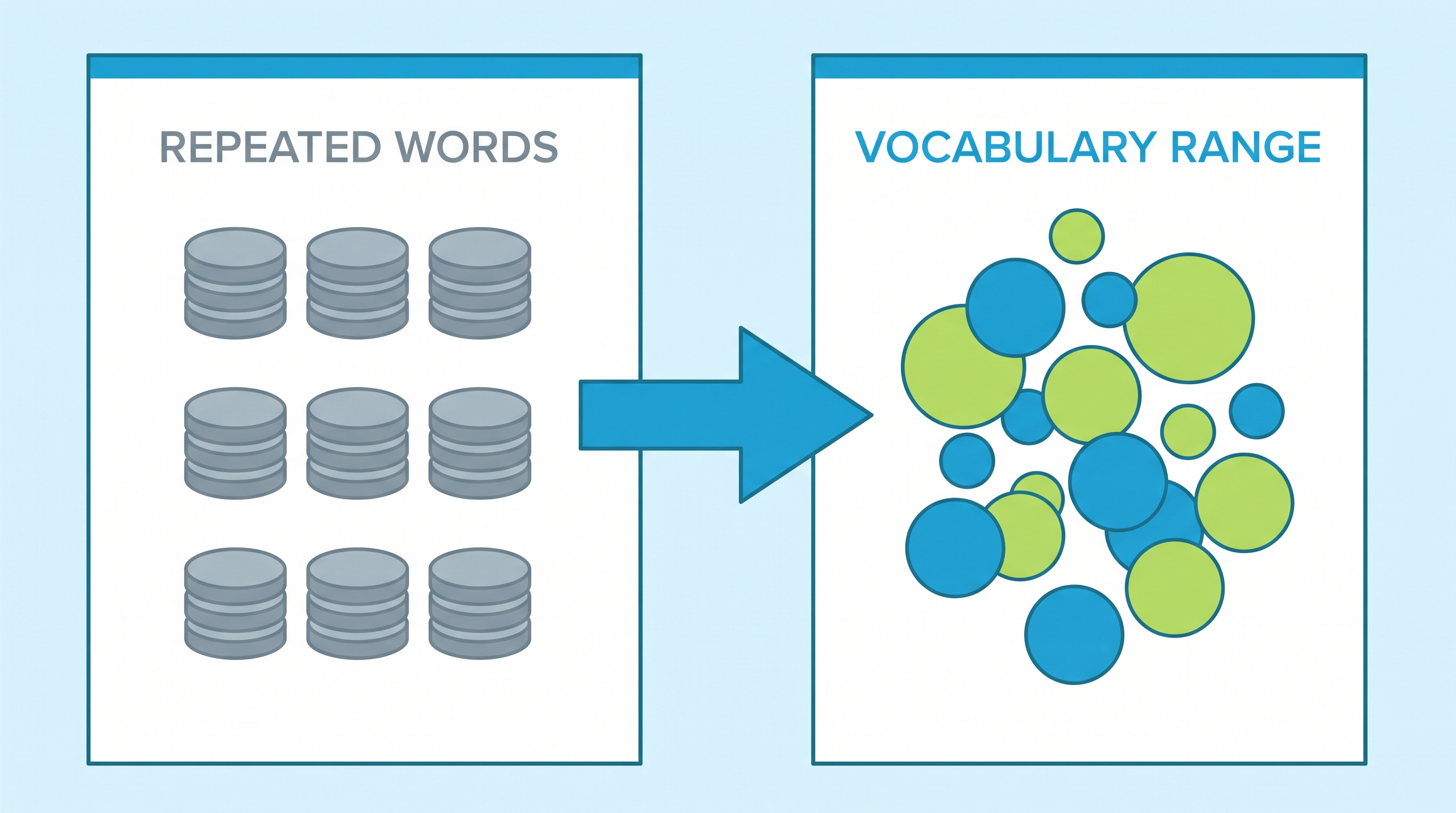
The first sign is repetition of a small set of words. If “important,” “society,” and “people” appear frequently across your essay, your lexical range is narrow. The band descriptors reward vocabulary that shows flexibility: different words for the same concept, accurate collocations, and topic-specific terms used appropriately.
The second sign is incorrect word choice. Using a sophisticated-sounding word in the wrong context signals limited understanding. At Band 6, errors in word choice occur alongside appropriate vocabulary; at Band 7, vocabulary is used with some flexibility and precision, with fewer such errors.
If you reach for a thesaurus without checking how words are used, or memorise vocabulary lists without context, this criterion deserves attention.
Recognising a Grammatical Range and Accuracy Problem in Your Writing
Grammatical Range and Accuracy measures two things: the variety of grammatical structures you use and how accurately you use them. Many candidates underperform on one while overlooking the other.
A range problem means relying on simple sentence structures. An essay built almost entirely on short subject-verb-object sentences will score lower on this criterion even when those sentences are correct, because range rewards complexity: relative clauses, conditionals, passive constructions, and varied openings.
An accuracy problem means attempting more complex structures but making systematic errors: mixed tenses without logic, missing articles before countable nouns, or recurring preposition mistakes. These errors penalise accuracy even when range is strong.
The two problems compound each other. Using only simple structures limits range; attempting complex grammar with many errors reduces accuracy. The highest-scoring responses balance both.
The Most Common Reason IELTS Writing Candidates Miss Their Band Target
The single most common cause of surprise is using fluency as a proxy for all four criteria. When writing flows and feels natural, it is easy to assume everything is performing well. But fluency, in the sense of smooth, confident prose, signals primarily Coherence and Cohesion. It tells you very little about your Lexical Resource range, your Task Achievement completeness, or your Grammatical Range.
This is why candidates who have written well in English for years can still receive a band below their target. Their fluency is genuine. What they have not practised is the specific performance each criterion requires: a complete task response, structured paragraphs, varied vocabulary, and complex grammar used accurately.
According to the British Council’s guidance on how IELTS is assessed, each criterion is scored independently. That distinction turns “why did I fail IELTS Writing” into a specific revision target.
Targeted Criterion Practice Versus Simply Writing More
The instinctive response to a lower-than-expected band is to write more: longer essays, more often, faster. This only helps if the practice targets the actual problem.
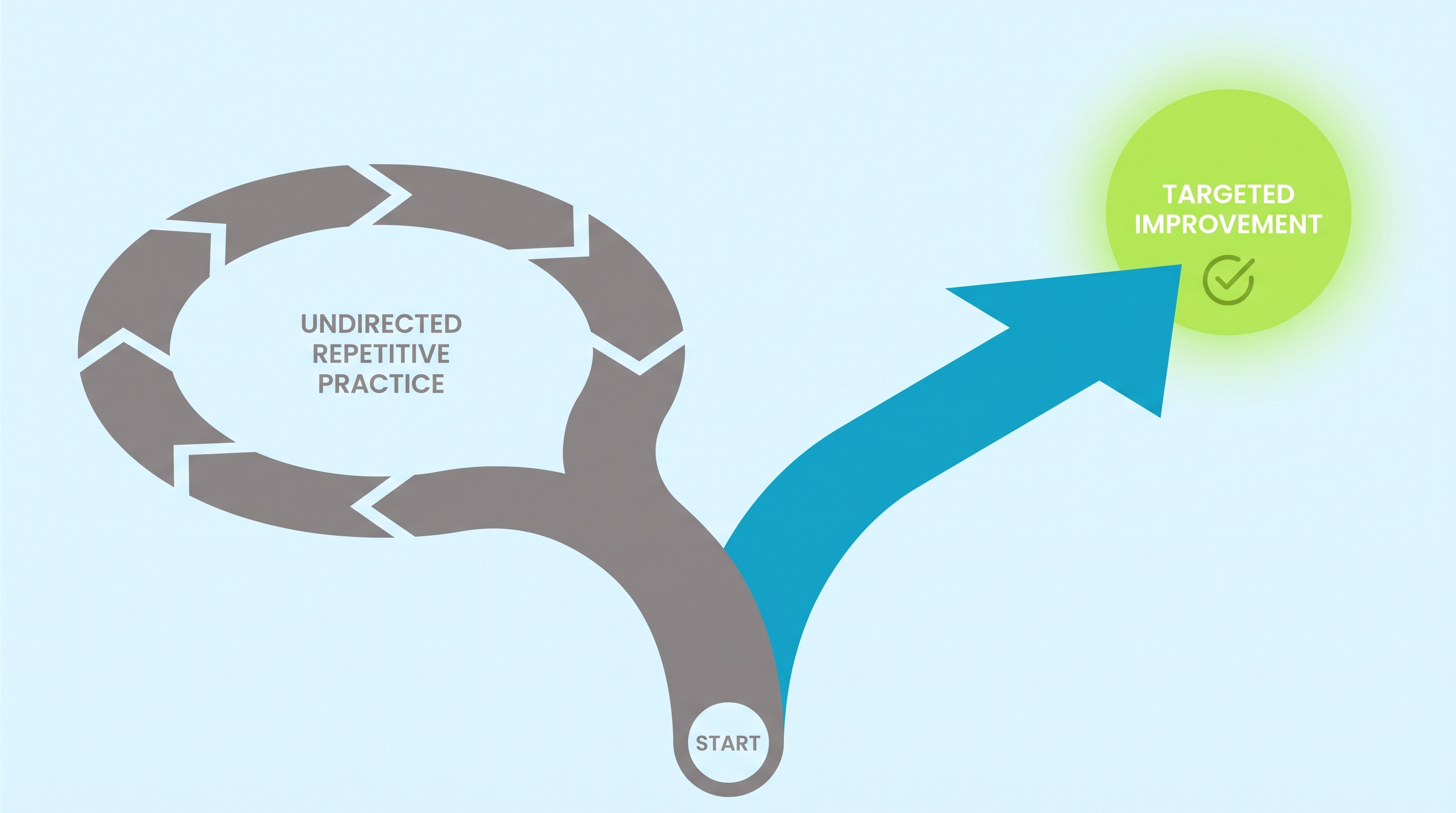
Undirected practice reinforces existing patterns. Writing more essays the same way produces more essays with the same weakness, since practice without criterion-level feedback cannot separate what is working from what is not.
Targeted practice means identifying the criteria where your score sits lowest, then organising each session around those dimensions. For Task Achievement, that might mean checking after every essay that all parts of the task are addressed. For Lexical Resource, it might mean replacing every repeated word in a finished paragraph.
The Speechful blog’s IELTS Writing Task 1 guide is a useful reference if your Task Achievement diagnostic points to Task 1 responses, where completeness requirements differ from Task 2.
How Much Does One Underperforming Criterion Lower Your Overall Writing Band?
Within a single task, the four criteria carry equal weight. Scores for that task are averaged and rounded to the nearest 0.5, so improving one criterion can shift that task’s band without changing the other three.
Consider a Task 2 response scored at 7.0 on Task Response, Coherence and Cohesion, and Grammatical Range and Accuracy, but 5.5 on Lexical Resource. The average is 6.625, rounding to a Task 2 band of 6.5. If Lexical Resource improves to 6.0, the average becomes 6.75, rounding to 7.0.
The final Writing band combines both tasks with unequal weight: (Task 1 band + 2 x Task 2 band) divided by 3. Task 2 carries twice the influence of Task 1, so improving a weak criterion on Task 2 moves the overall result more than the same improvement on Task 1. Find the criterion where your marks are lowest and address it precisely.
What to Do Once You Have Found Your Weakest Criterion
Once you have a specific criterion in mind, practise against it with feedback that scores against it. “This reads well” is not criterion-level feedback. You need to know: is your Task Response complete? Is your paragraph cohesion mechanical or natural? Does your vocabulary show range?
Start with your most recent IELTS answer. Read it against one criterion at a time using the descriptions in this article, and note where your response falls short of the Band 7 description. The 10 evidence-based improvement strategies on the Speechful blog cover preparation approaches that apply across criteria and are worth reading alongside any criterion-specific plan.
Once you have a diagnosis and a practice target, test it with real feedback. Submit a Writing Task 2 response to Speechful’s IELTS Writing AI grader and receive sentence-by-sentence feedback scored against all four official criteria. That is how a diagnosis becomes a measurable improvement.