
Fluent English Vocabulary Building: Why Passive Learning Quietly Stalls Your Progress (And What to Do Instead)
You have been working on English vocabulary building for years. Films, novels, word lists, apps. You understand almost everything you encounter. But the moment a conversation needs a specific word, it simply is not there. You studied it. You tested yourself on it. It still does not show up when it actually matters.
There is a name for this in applied linguistics: the receptive-productive vocabulary gap. It describes the difference between words you can recognise and words you can produce under the real pressure of a conversation. Understanding why it happens is what separates learners who plateau from those who keep making progress.
Here is the research behind it, and a practical approach that actually moves words from recognition into natural use.

Why Do New English Words Keep Disappearing From Your Memory?
The answer lies in how memory consolidates new information. Paul Nation, emeritus professor of applied linguistics at Victoria University of Wellington and one of the most widely cited researchers in vocabulary acquisition, has shown that a new word typically requires between 10 and 20 meaningful encounters before it consolidates in long-term memory. Most learners encounter a word once or twice, then move on.
The deeper problem is that passive encounters do not build the same memory trace as active retrieval. Recognition memory and production memory are distinct. You can recognise a word when you see it in text without having any ability to produce it in speech or writing. Seeing a word in a subtitle or reading it in a novel builds familiarity. It does not build retrievability.
If new words keep disappearing despite repeated study, the likely reason is that those sessions are building recognition without building retrieval. Effective English vocabulary building requires retrieval practice, not just more exposure.
The One English Vocabulary Building Mistake That Holds Most Learners Back
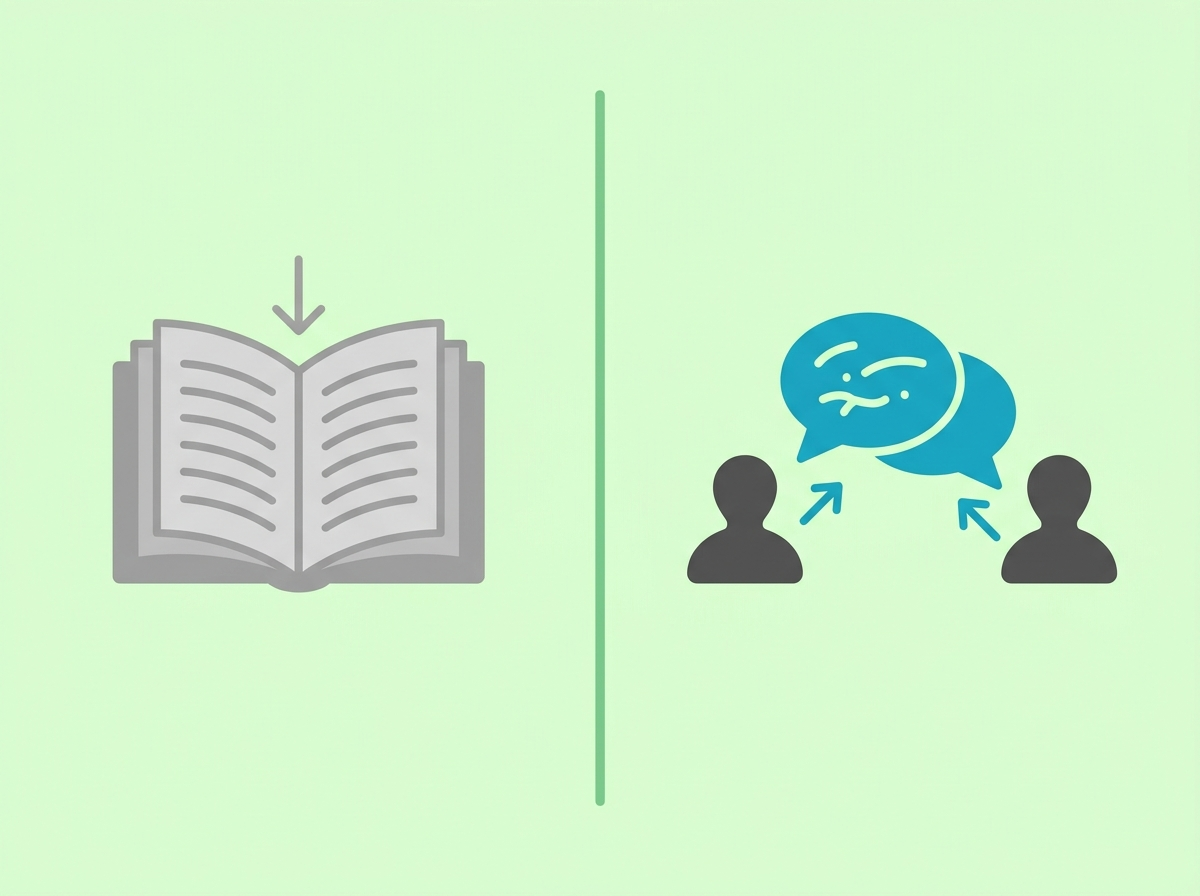
The single most common mistake in English vocabulary building is treating exposure as equivalent to practice. Learners assume that encountering a word often enough in reading or listening will eventually make it available when they speak or write. For recognition, this is broadly true. For production, it is not.
Applied linguistics draws a clear line between receptive vocabulary (words you understand when you encounter them) and productive vocabulary (words you can use accurately in real communication). Nation’s research across multiple decades shows that productive vocabulary is typically two to three times smaller than receptive vocabulary for intermediate learners.
Passive exposure builds receptive vocabulary efficiently. It does not build productive vocabulary at the same rate, because production requires a fundamentally different cognitive operation: retrieving the word yourself, under communicative conditions, rather than recognising it when it arrives. Learners who understand this distinction can stop waiting for passive exposure to do a job it was never designed to do.
Why Reading More English Does Not Automatically Build the Vocabulary You Need for Conversation
[IMAGE PLACEHOLDER: open book next to a speech bubble containing question marks — section on reading and its limits for producing vocabulary in conversation]
Reading is excellent for expanding receptive vocabulary. Cambridge English‘s vocabulary research confirms that extensive reading significantly increases the range of words learners can recognise and understand. The problem is not that reading does not work. It does, for what it is designed to do.
Reading is a one-directional relationship with language. Words come to you. You do not produce them. Producing the right word yourself, under time pressure, while managing grammar and sentence structure simultaneously, is precisely what speaking requires. Those are different cognitive processes.
A learner with 8,000 passive vocabulary items may be able to produce only 2,000 to 3,000 of them fluently in spontaneous conversation. This is not unusual. It is the expected outcome of a study diet dominated by passive input. For English vocabulary building that results in real conversational ability, practice must involve production: speaking, writing, or retrieval under conditions that simulate genuine communication. Reading remains valuable, but relying on it alone will not complete the English vocabulary building journey from recognition to natural use.
How Many Times Do You Need to Practise a Word Before It Feels Natural?

Nation’s vocabulary acquisition research gives a useful benchmark: roughly 10 to 20 quality encounters before a word consolidates in memory. The word “quality” matters here. Encountering the same item passively 20 times delivers considerably less consolidation than 10 active retrievals in different communicative contexts.
The Common European Framework of Reference for Languages (CEFR), published by the Council of Europe, estimates that C1-level competence requires approximately 8,000 to 9,000 word families. Moving from B2 to C1 is not simply a matter of adding more words to a passive list. It requires moving a substantial proportion of existing vocabulary from receptive knowledge to productive command, and that transition happens through retrieval, not through recognition.
Effective English vocabulary building at every stage therefore requires building retrieval moments into practice. When you learn a new word, aim for at least five retrieval opportunities across the following two weeks: use it in a written sentence, say it in a conversation, answer a question that genuinely requires it. Each retrieval strengthens the production trace and makes the word more available the next time you need it.
When Flashcard Apps and Vocabulary Lists Fall Short (And When They Actually Help)

Flashcard apps and vocabulary lists are effective tools for building the initial recognition layer. They work well for encoding that a word exists, what it broadly means, and roughly how it is used. For learners genuinely expanding vocabulary breadth, spaced repetition systems have solid research backing.
Where these tools fall short is in the transition from recognition to production. A flashcard test asks you to match a word to a definition or translation. It does not ask you to retrieve that word naturally in the middle of a sentence while managing the communicative goal of a real conversation. As explored in IELTS Writing Vocabulary: How to Use the Academic Word List, even structured word lists deliver substantially more value when learners move quickly from recognition into contextual use.
Vocabulary lists also teach words in isolation, away from the collocational patterns where those words naturally appear. Knowing a word and knowing how to combine it with other words are different skills. The best use of flashcard apps is at the initial recognition stage, not as the final destination of English vocabulary building.
Does Writing Practice Build Vocabulary Faster Than Reading?
Writing sits between reading and speaking on the vocabulary activation scale. It requires production (you must retrieve the word yourself) but provides more time and control than live conversation. You can pause, reconsider, and choose words deliberately. This makes writing a practical bridge between passive exposure and the real-time retrieval that speaking demands.
Consistent writing practice improves lexical accuracy, collocational knowledge, and stylistic range, particularly when feedback is part of the process. Producing a word in a sentence and receiving correction on whether you used it naturally creates the corrective loop that accelerates productive vocabulary development.
Writing is more effective than reading for vocabulary activation. It is less effective than speaking for building retrieval speed under communicative pressure. The most effective English vocabulary building approach therefore combines all three modes: reading for breadth, writing for accuracy and collocational depth, speaking for retrieval speed. Relying exclusively on any one mode develops one dimension of vocabulary knowledge while leaving the others behind.
Goal-Directed Speaking vs Word Lists: Which Builds Usable Vocabulary Faster?

Goal-directed speaking means practising in scenarios where you must produce a specific word or phrase to achieve a communicative objective. The goal creates real communicative pressure, and that pressure is the mechanism that separates productive vocabulary from passive recognition.
As discussed in How Daily English Conversation Practice Builds Confident Fluency in Weeks, learners who engage in regular goal-directed conversation develop retrieval speed that reading and word lists do not replicate. Word lists build recognition faster in the early stages. Goal-directed speaking builds production faster at every stage.
These are not competing methods; they work on different aspects of vocabulary knowledge. For sustainable English vocabulary building, use word lists to identify which words to target for active practice, then move those words into goal-directed speaking and writing as quickly as possible. A word that stays permanently in a list but never gets produced under communicative pressure is a word that will remain in the passive vocabulary indefinitely.
How to Build Vocabulary for Your Specific English Goal
Generic English vocabulary building treats all words as equally worth learning. Targeted English vocabulary building means identifying the words you need for the specific contexts where you use English: professional meetings, academic writing, or everyday conversation. Prioritising those words for active practice delivers faster results than any general expansion plan.
A learner preparing for an English job interview needs a different vocabulary profile than a learner working on casual social English. Academic writers need collocational depth in a subject domain. Knowing your context lets you direct practice toward words that will be immediately useful, which increases both motivation and retention.
The starting point is an honest audit of where you actually use English and where vocabulary lets you down. If gaps appear most in professional contexts, that is your target domain. If friction arises in casual conversation, that determines your priority. Vocabulary practice that is disconnected from your real use contexts is slower to stick and less durable, regardless of how many words you add to your lists.
Expanding vs Deepening Your English Vocabulary: Which Matters More for Fluency?

For intermediate learners, English vocabulary building at B2 level and above requires a different focus than at earlier stages. Expanding vocabulary means learning more words. Deepening vocabulary means using the words you already know with greater accuracy, collocational range, and natural fluency. Both matter, but most intermediate learners need significantly more depth than breadth.
At B2 level, a learner typically has sufficient vocabulary breadth for most everyday situations. The plateau feeling (knowing the words exist but being unable to produce them under conversational pressure) is almost always a depth problem, not a breadth problem.
Depth includes knowing which collocations a word takes (you make a decision, not do a decision), which register it belongs to (commence is formal; start is neutral), and which grammatical patterns it fits. This kind of knowledge develops only through extended use, reading in context, and feedback on your real output. The type of vocabulary depth that affects speaking naturalness is explored in IELTS Speaking Common Mistakes. For learners who feel stuck despite years of study, the answer is rarely to learn more words. It is to practise the words they know in more demanding, production-focused contexts.
A Practical 30-Day English Vocabulary Building Routine for Intermediate Learners
An effective 30-day English vocabulary building routine needs all three components: breadth (new items), depth (collocations and register), and production (retrieval under communicative pressure).
Week 1. Identify 30 words relevant to your specific English context. For each, note its most common collocations and one model sentence. Enter these into a spaced repetition app for daily recognition review.
Week 2. Move words from recognition to production. Write a short paragraph each day using three to five target words in their natural collocational forms. Prioritise sentences that reflect situations you actually encounter.
Week 3. Take each word into speaking practice. Set a conversational goal (a discussion topic, a task, a scenario) that requires producing your target vocabulary. The communicative goal forces retrieval under pressure, which is what moves a word from passive to active.
Week 4. Consolidate. Revisit words that still feel effortful in speaking or writing. Identify uncertain collocations and adjust next month’s word selection based on the real gaps you discovered.
One honest note on timing: moving a word from recognition to fully fluent production typically takes three to four weeks of consistent retrieval practice. English vocabulary building is a cumulative process, and that is precisely why a structured routine produces results that passive study cannot match.
The most direct path to active vocabulary use is goal-directed production practice: conversations where achieving an objective requires you to produce specific words in context. Speechful’s Speak with AI gives you exactly that. Set a conversation goal, produce your target vocabulary to achieve it, and turn known words into usable ones.