IELTS Writing Task 2 Topics 2026: The Themes Every Candidate Needs to Practise
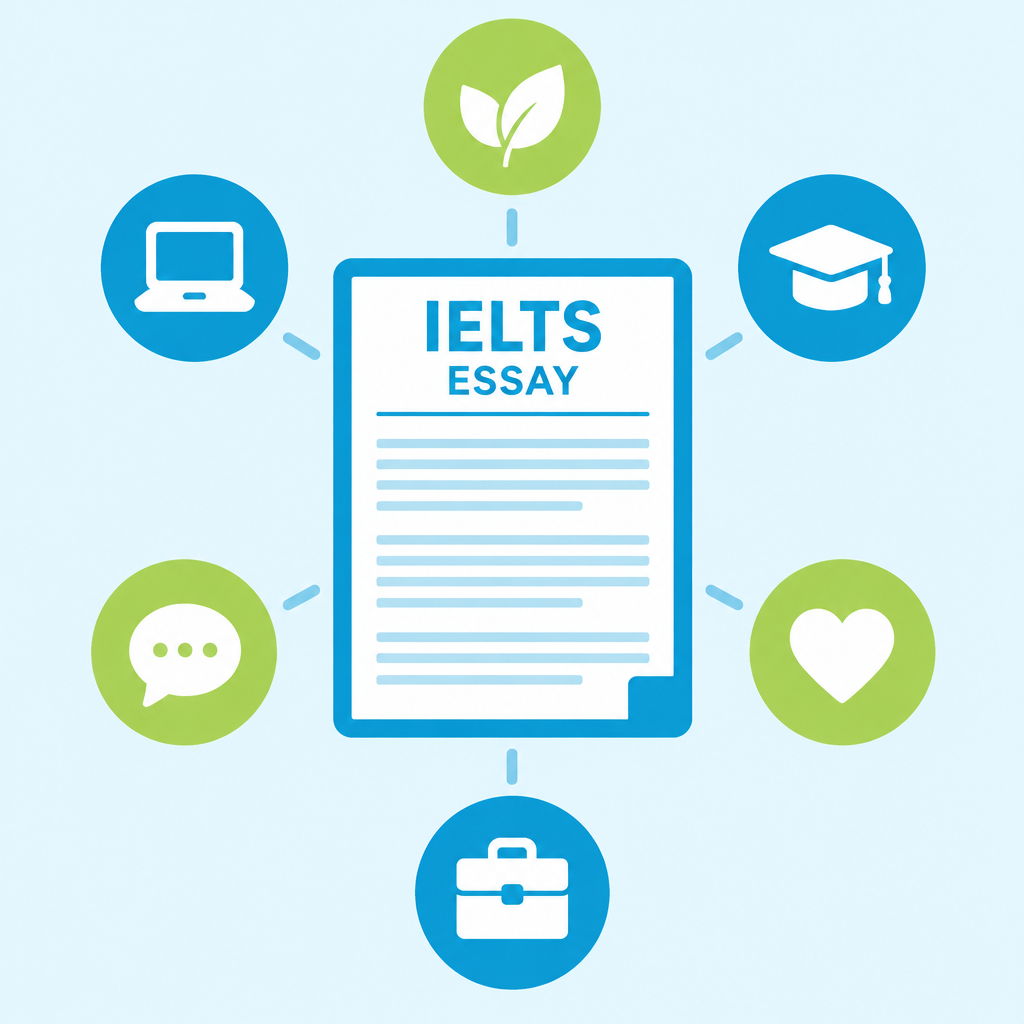
Quick answer: IELTS Writing Task 2 draws from six recurring theme categories: technology and AI, environment and climate, education, society and culture, health and lifestyle, and work and economics. In 2026, test-takers have reported high frequency of AI and work topics. Practising at least two essay types within each theme prepares you for any prompt on exam day.
You open your IELTS Writing Task 2 question and read: “Some people believe that artificial intelligence will fundamentally change the nature of work. Others argue that its impact has been exaggerated. Discuss both views and give your opinion.” You know the topic, but you have never written a structured essay on it under timed conditions. This scenario catches many candidates off guard: they practised essay technique without practising topic fluency.
This guide covers the IELTS Writing Task 2 topics 2026 test-takers have reported most often, and the six recurring categories that have always underpinned them.
What Are the Main Theme Categories in IELTS Writing Task 2?
IELTS Writing Task 2 is assessed against the same four criteria in both Academic and General Training modules: Task Response, Coherence and Cohesion, Lexical Resource, and Grammatical Range and Accuracy. The topics themselves fall into six recurring categories that the test has drawn from consistently over many years: technology and AI, environment and climate, education, society and culture, health and lifestyle, and work and economics.
Knowing these categories gives you a framework for building a bank of ideas and vocabulary before your exam. When a prompt arrives on test day, identifying its category takes seconds, leaving more thinking time for your argument.

British Council, IDP IELTS, and Cambridge English, the joint administrators of the IELTS test, describe the main Task 2 question types as: opinion (agree/disagree), discussion (both views), problem-solution, advantage-disadvantage, and two-part questions. A single topic category can produce any of these five question types.
Which IELTS Writing Task 2 Topics Have Been Reported Most Frequently in 2026?
The IELTS authorities do not publish exam questions. What circulates online comes from candidates sharing prompts they recall after sitting. Practitioners compile these reported topics into publicly available frequency guides.
Based on compiled test-taker reports from 2026, the most frequently mentioned categories have been technology and AI (particularly automation, AI in the workplace, and social media effects) and environment and climate (particularly government versus individual responsibility for climate action). Education and work themes have also appeared frequently. Society and culture, health, and economics topics appear with moderate regularity throughout the year.
These reported frequencies are useful for prioritising your practice order. They are not a guarantee of what appears on your exam.
How Reliable Are Reported IELTS Essay Topic Lists?
No topic list published online, including this article, represents the official IELTS exam schedule. The test authorities do not release upcoming or past exam papers. What you can rely on is the pattern: the six categories above have appeared consistently for many years, and 2026 reports confirm that.
Treat reported IELTS Writing Task 2 topics from 2026 or any year as realistic practice prompts, not as predicted questions. Your goal is to be able to argue any reasonable prompt within each category, not to guess the exact wording in advance. IELTS can phrase a question about AI in the workplace differently across every sitting while drawing on the same underlying topic category.
Topic-based practice gives you faster idea retrieval and more confident argument construction on exam day.
What Technology and AI Topics Have Appeared in IELTS Writing Task 2?
Technology and AI has been the category most frequently reported by 2026 test-takers. Specific prompt types include: automation and job displacement, AI in education, social media effects on communication and relationships, and whether technology isolates or connects communities.
A typical discussion prompt from this category: “Some people believe that artificial intelligence will improve productivity in the workplace. Others think it will lead to widespread unemployment. Discuss both views and give your opinion.” This question type requires substantive engagement with both positions before stating and supporting your own view, not a quick summary of each side followed by “it depends.”
The IELTS Writing Band Descriptors (published jointly by British Council, IDP IELTS, and Cambridge English) make this distinction precise: a Band 6 essay addresses the task, while a Band 7 essay addresses all parts of the task. On a discussion question, all three components (view A, view B, your opinion) each receive developed attention.

How Have Environment and Climate Topics Evolved in IELTS Writing Task 2?
Environment and climate is a perennial IELTS Writing Task 2 category, but the framing in 2026 reports has shifted from general pollution prompts to responsibility-framing questions. Reported prompts have included: “Should individuals or governments take primary responsibility for addressing climate change?” and “Is economic development more important than environmental protection?”
These prompts test whether you can argue a specific position on responsibility, not just list environmental problems and generic solutions. A Band 6 Task Response on this topic often addresses climate change in general without directly engaging the specific responsibility angle the question asks for. To reach Band 7, your argument must answer the actual question posed.
For annotated examples of this distinction at Band 6 versus Band 7, the guide to IELTS band score differences in essays walks through the same prompt at two score levels.
What Education and Society Topics Are Candidates Encountering in 2026?
Education topics reported in 2026 cluster around: whether university education should be free or funded by students, online learning versus traditional classrooms, and whether schools should prioritise vocational skills over academic subjects. These prompts often require an opinion or advantage-disadvantage structure, rewarding candidates who argue a specific, supported position rather than balanced commentary that avoids committing to a view.
Society and culture topics include urbanisation, cultural globalisation, and intergenerational issues such as responsibilities toward the elderly. These frequently use the “to what extent” format, asking for a nuanced position on degree rather than a simple agree/disagree.
Both Academic and General Training use the same Task 2 format and criteria. The guide to differences between Academic and General Training Writing clarifies what stays the same and what differs.
How Do Health and Work Themes Appear in IELTS Task 2?
Health topics include diet and lifestyle choices (particularly whether governments should regulate unhealthy food), mental health awareness, and healthcare spending. Work topics include remote working, work-life balance, and the effects of automation on employment. Reported IELTS Writing Task 2 prompts in 2026 on work themes have overlapped substantially with the technology category, so preparation for one supports the other.
Opinion-type questions are common in both health and work categories. Task Response at Band 7 on an opinion question means your position is clear throughout the essay, supported with specific reasoning in every body paragraph, not simply stated in the introduction and then left unattended.

What Is the Difference Between Opinion, Discussion, and To-What-Extent Questions on the Same Topic?
The same topic category produces completely different essays depending on the question type. Taking AI in education as an example:
| Question type | Prompt shape | What the essay requires |
|---|---|---|
| Opinion | “AI will replace teachers. Do you agree?” | One clearly argued position throughout; the other side may be acknowledged briefly |
| Discussion | “Some think AI helps education, others disagree. Discuss both views and give your opinion.” | Both views developed, then your position stated and supported |
| To what extent | “To what extent has AI improved education?” | A nuanced position on degree, with limitations of the improvement addressed |
| Two-part | “What benefits does AI bring to education? Should it be used in all schools?” | Two separate questions, each requiring a direct answer in their own paragraph |
Misidentifying the question type affects the entire essay structure. Recognising it in the first 30 seconds of reading the prompt is one of the highest-return exam skills you can develop.
What Are the Most Common Mistakes Writing About Unfamiliar IELTS Task 2 Topics?
The most common mistake is staying at the level of a generic claim: “Technology has both advantages and disadvantages.” This reads as Band 5-6 Task Response because it contains no developed argument. An examiner reading this knows the candidate cannot generate specific, supported ideas on this topic under timed pressure.
It feels neutral and therefore safe, but an essay that avoids a concrete position cannot score well on Task Response no matter how grammatically accurate the prose is. Commit to a position and support it with one concrete reason per body paragraph.
The second most common mistake is writing the wrong essay type because the question type was misread. If you want to check how your essays score against each criterion before your exam, the IELTS essay self-assessment guide walks through each criterion with a worked example.

How Does Practising Topics Improve Your Task Response and Coherence Scores?
Task Response and Coherence and Cohesion are the two criteria most responsive to topic-specific practice. Practising with a specific topic category builds two things: a set of developed ideas and relevant vocabulary you can recall under timed conditions, and familiarity with how different question types on that topic require different essay structures.
Repeated practice on the same topic category with feedback shows whether your ideas are developed enough for Task Response and whether your argument reads clearly for Coherence and Cohesion. Both improve more from topic-focused practice than Grammatical Range and Accuracy does.
A practical preparation plan for a candidate with 4 to 12 weeks before their exam: practise at least one opinion and one discussion prompt from each of the six categories. That is around 12 practice essays with targeted feedback, covering the full range of what IELTS Writing Task 2 draws from.
Practise one of the 2026 IELTS Writing Task 2 topics from this article as a full essay and get scored against all four criteria with Speechful’s IELTS Writing Task 2 grader. Sentence-by-sentence feedback shows where your Task Response is clear and where it needs development before exam day.