
IELTS Writing Task 1 Academic: Describing Charts, Graphs & Other Images

This guide covers everything you need to master IELTS writing task 1 in the Academic exam. By the end, you’ll know exactly how to describe visual data, structure your response for maximum marks, and avoid the mistakes that cost most candidates valuable points.
What Is IELTS Writing Task 1 Academic and How Is It Structured?
IELTS writing task 1 Academic requires you to describe, summarise, or explain visual data in at least 150 words. The official IELTS website confirms you should spend no more than 20 minutes on this section.
The task tests three core abilities:
- Identifying key trends and significant features
- Making accurate comparisons between data points
- Presenting information objectively without personal opinion
Unlike Task 2, IELTS writing task 1 demands pure objectivity. You’re reporting what the data shows, not arguing a position or sharing your views.
Types of Charts and Graphs in IELTS Writing Task 1 Academic
Knowing what visual formats appear in the exam helps you prepare strategically. The IDP lists these common question types:
| Visual type | What it shows | Key Focus |
| Line graphs | Changes over time | Trends, fluctuations, peaks |
| Bar charts | Comparisons between categories | Highest/lowest values, differences |
| Pie charts | Proportions of a whole | Percentages, largest/smallest segments |
| Tables | Precise numerical data | Specific figures, rankings |
| Process diagrams | Steps in a sequence | Stages, order, connections |
| Maps | Geographical changes | Developments, locations, before/after |
Line graphs and bar charts appear most frequently. Process diagrams and maps show up less often but require different descriptive approaches entirely.
How Should You Structure Your IELTS Writing Task 1 Response?
A four-paragraph structure works best for IELTS writing task 1. This format ensures clarity and systematically addresses all assessment criteria.
Paragraph 1: Introduction
Paraphrase the question in your own words. Never copy the rubric directly. Change vocabulary and sentence structure while preserving the meaning.
Paragraph 2: Overview
This paragraph separates Band 6 responses from Band 7+. Highlight 2-3 key trends or features without including specific numbers. Examiners look for your ability to identify the main patterns at a glance.
Paragraphs 3-4: Body
Present specific data points grouped logically. Organise by time period, category, or trend direction. Support your overview observations with precise figures.
The overview paragraph deserves special attention. Many candidates skip straight to data, which limits their Task Achievement score. Your overview demonstrates analytical thinking, the ability to see the big picture, not just the small details.
Essential Vocabulary for Describing Trends in IELTS Writing Task 1

Strong responses use varied, precise vocabulary. Repeating “increased” and “decreased” throughout your response signals limited lexical range.
For upward movements: rose, climbed, grew, surged, soared, jumped, rocketed. Each carries slightly different intensity. “Rocketed” implies dramatic change; “grew” suggests gradual increase.
For downward movements: fell, dropped, declined, plummeted, decreased, dipped, slumped. Again, “plummeted” conveys sudden dramatic fall, while “dipped” suggests minor temporary decline.
For stability: remained constant, stayed stable, plateaued, levelled off, held steady.
Adverbs add precision: sharply, dramatically, gradually, steadily, slightly, marginally, significantly.
Building topic-specific vocabulary before your exam date gives you the tools to describe any data pattern confidently. Knowing the word and using it correctly is what separates a Band 6 from Band 7.
Effectively Describing and Comparing Data in IELTS Writing Task 1 Academic
Selecting key features matters more than listing every data point. Examiners don’t want a number-by-number rundown. They want to see your analytical skills.
Focus on these elements:
- Highest and lowest values
- Most significant changes
- Notable deviations or exceptions
- Overall patterns and general trends
Comparative language strengthens your response. Phrases like “compared to,” “in contrast,” “significantly higher than,” and “nearly double the figure for” demonstrate sophisticated data handling.
Here’s the catch: you must balance detail with selectivity. Three to four main trends, supported by accurate data, outperform full coverage of every data point. Quality trumps quantity in IELTS writing task 1.
When multiple categories exist, group them logically. Compare similar items together rather than jumping randomly between unrelated data points.
Common Mistakes to Avoid in IELTS Writing Task 1
Candidates lose marks for predictable errors. Awareness helps you aviud these pitfalls.
Missing the overview: This remains the most damaging mistake. If you miss the overview, you will get Band 5 or below in Task Achievement. Two sentences identifying main trends can unlock higher bands.
Including personal opinions: Phrases like “I think” or “this is good because” have no place in IELTS writing task 1. You’re reporting facts, not arguing.
Copying the question: Examiners penalise direct copying. Paraphrase the introduction using synonyms and alternative structures.
Describing every data point: Selective analysis demonstrates higher-level thinking. Listing every number suggests you can’t identify significance.
Ignoring accuracy: Wrong figures or misread data destroy your credibility. Double-check numbers before writing them.
Poor time management: Spending 30 minutes on Task 1 leaves insufficient time for the higher-weighted Task 2. Stick to 20 minutes maximum.
Writing under 150 words: The minimum exists for a reason. Responses under 150 words receive automatic penalties regardless of quality.
How the Scoring Criteria Work for IELTS Writing Task 1
Four criteria contribute equally to your band score, each worth 25%. IDP publishes detailed band descriptors explaining exactly what examiners seek.
| Criterion | What it measures | Key requirements |
| Task Achievement | How well you address the task | Clear overview, key features covered, accurate data |
| Coherence and Cohesion | Logical organisation and flow | Paragraph structure, linking words, progression |
| Lexical Resource | Vocabulary range and accuracy | Varied word choice, appropriate collocations, spelling |
| Grammatical Range and Accuracy | Sentence structures and correctness | Complex sentences, error-free writing, punctuation |
Understanding these criteria helps you understand your current level and identify specific areas for improvement. A candidate scoring Band 6 for Lexical Resource but Band 7 for Grammar knows exactly where to focus practice.
Single Charts Versus Multiple Charts in IELTS Writing Task 1
Single charts require deep analysis. You have one data source, so examine trends thoroughly. Identify changes over time for dynamic data or compare categories for static data like pie charts.
Multiple charts demand different skills. When facing a bar chart alongside a table, your job is finding connections. Look for relationships, contrasts, or patterns across both visuals.
For single charts:
- Focus on 2-3 major trends
- Group data by time period or category
- Provide detailed supporting figures
For multiple charts:
- Identify the relationship between the two visuals
- Summarise each visual’s main trend in your overview
- Dedicate body paragraphs to each chart or group by theme
The key action for multiple charts? Demonstrate analytical skills by drawing comparisons across both data sources. Treating them as completely separate exercises misses the point.
Time Management and Word Count for IELTS Writing Task 1
Twenty minutes. One hundred and fifty words minimum. These constraints shape everything.
IDP Education IELTS recommends spending your time this way:
- 2-3 minutes analysing the visual and planning
- 12-14 minutes writing
- 3-5 minutes checking and editing
The higher score answers are 170-190 words. Writing more than 200 words takes time away from Task 2, and the extra words usually don’t help your score.
Before you start writing, decide what main points you want to make. Look at the important numbers or trends. This helps you write clearly and stay focused.
How to Get Band 7 or Higher in IELTS Writing Task 1 Academic
Good test-takers have similar habits.
Use your own words. Don’t copy words from the question. Say the same thing in a different way.
Write a clear summary first. Before giving specific numbers, tell the reader 2-3 main things you notice. Start each paragraph with a sentence that tells the reader what that paragraph is about.
Use different sentence types. This is what separates Band 6 from Band 7. Write some short sentences and some longer ones. Use passive voice when describing steps in a process. Compare things naturally.
Choose precise words. “Rose dramatically” is better than “went up a lot.” Phrases like “reached a peak” and “experienced a decline” show strong English skills.
Check your work. Spelling mistakes, missing words like “a” or “the,” and verb errors will lower your score. Save 3-5 minutes at the end to read your answer again.
Practice with real tests. You can read about IELTS online to understand the test, but the best way to improve is to write full answers with a timer.
Practise IELTS Writing Task 1 With Targeted Feedback
Reading about IELTS writing task 1 strategies helps, but practice with feedback accelerates improvement. The challenge? Getting quality feedback on your actual writing.
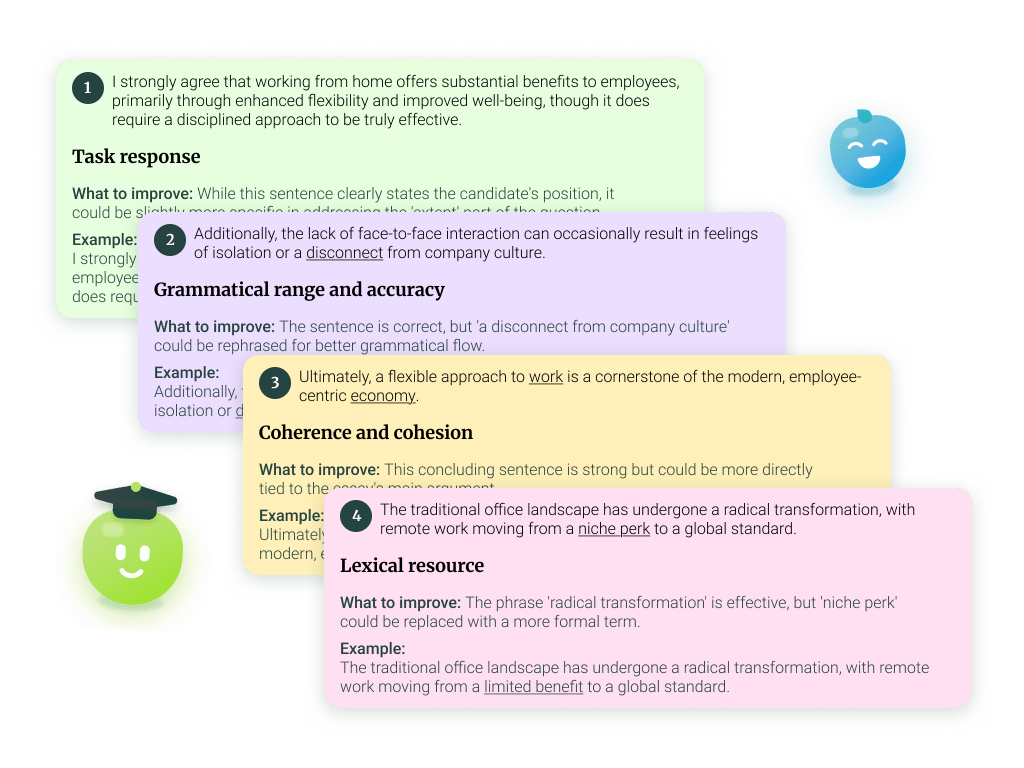
Speechful AI’s IELTS Writing Assessment solves this problem. The platform provides unlimited mock tests covering every question type appearing in the exam. Whatever visual format you encounter on test day, you’ll have practised it.
Each response receives line-by-line correction with clear explanations for every highlighted mistake. You see exactly what went wrong and how to fix it. The system scores your writing on all four criteria: Task Achievement, Coherence and Cohesion, Lexical Resource, and Grammatical Range and Accuracy.
Knowing your individual criterion scores reveals precisely what needs work. A candidate scoring Band 6.5 overall might discover they’re achieving Band 7 for Task Achievement but only Band 6 for Grammar. That specificity guides targeted practice.
Your Next Steps
IELTS writing task 1 rewards preparation. Learn the structure, build your vocabulary, practise under timed conditions, and get feedback on your responses.
Start by analysing sample high-scoring responses. Notice how they balance overview with detail, how they group data logically, how they vary vocabulary throughout.
Then write. Write often. Write under pressure. The gap between understanding IELTS writing task 1 and executing it well closes only through practice.





One Comment
Comments are closed.