Master the Two-Part Question IELTS Essay: A Confident Guide to Structure and Model Answers

You read the Task 2 prompt twice. Then a third time. Two separate questions, one after the other, and 40 minutes to answer both fully. This is the two part question IELTS essay format, and it trips up writers at every band level. Not because the language required is harder, but because the scoring penalty for getting it wrong is invisible until the results arrive.
The error is almost always structural: candidates write at length on one sub-question and give the other a sentence or two. The examiner applies the Task Response criteria and scores against the weaker of the two. The essay looks complete from the outside, but the task has not been fully addressed.
This guide explains what examiners look for, how the most common structural mistake works, and how to build a reliable approach before your test date.
What the Two-Part Question Format Actually Is in IELTS Writing Task 2
The two-part question is one of five Task 2 question types. Unlike discuss-both-views, opinion, or problem-solution prompts, it presents two direct, related questions at the end of the prompt. A typical example:
“In many countries, people are spending more time at work than ever before. Why is this happening? What can be done to improve the situation?”
This format asks candidates to address two specific and distinct points about a topic, without requiring a personal position or a case to argue. The two part question IELTS essay appears regularly across both Academic and General Training papers and carries the same Task Response weighting as any other Task 2 type. Your job is to answer both questions with equal seriousness.
Spotting a Two-Part Question Before You Begin Writing
The signal is unmistakable once you recognise it: two direct questions, each ending with a question mark, placed at the end of the prompt. Opinion essays end with “To what extent do you agree or disagree?” Two-part questions use different phrasing:
- “Why does this happen? What can be done?”
- “What are the causes of this problem? What effects does it have?”
- “Is this a positive or negative development? What changes would you suggest?”
The third example matters because the first question looks like it needs a yes-or-no answer. It does not. You are expected to state your evaluation and explain it briefly. Read both questions carefully before you plan, because they are not always the same type, and the second question sometimes follows from how you answer the first.

What Happens to Your Task Response Score When You Neglect One Part
Task Response accounts for 25% of your Writing Task 2 mark, alongside Coherence and Cohesion, Lexical Resource, and Grammatical Range and Accuracy. It directly measures whether you addressed what the question asked.
The Task Response band descriptors published by the British Council, IDP IELTS Australia, and Cambridge English at ielts.org describe Band 6 as addressing both parts of the task although some parts may be more fully covered than others. Band 7 requires: “addresses all parts of the task.”
In practice, a candidate who writes four rich paragraphs on one sub-question and a single weak paragraph on the other demonstrates Band 6 Task Response, regardless of how polished the vocabulary or grammar is elsewhere. Partial coverage is a Band 6 ceiling.
The Structural Mistake That Costs the Most Points
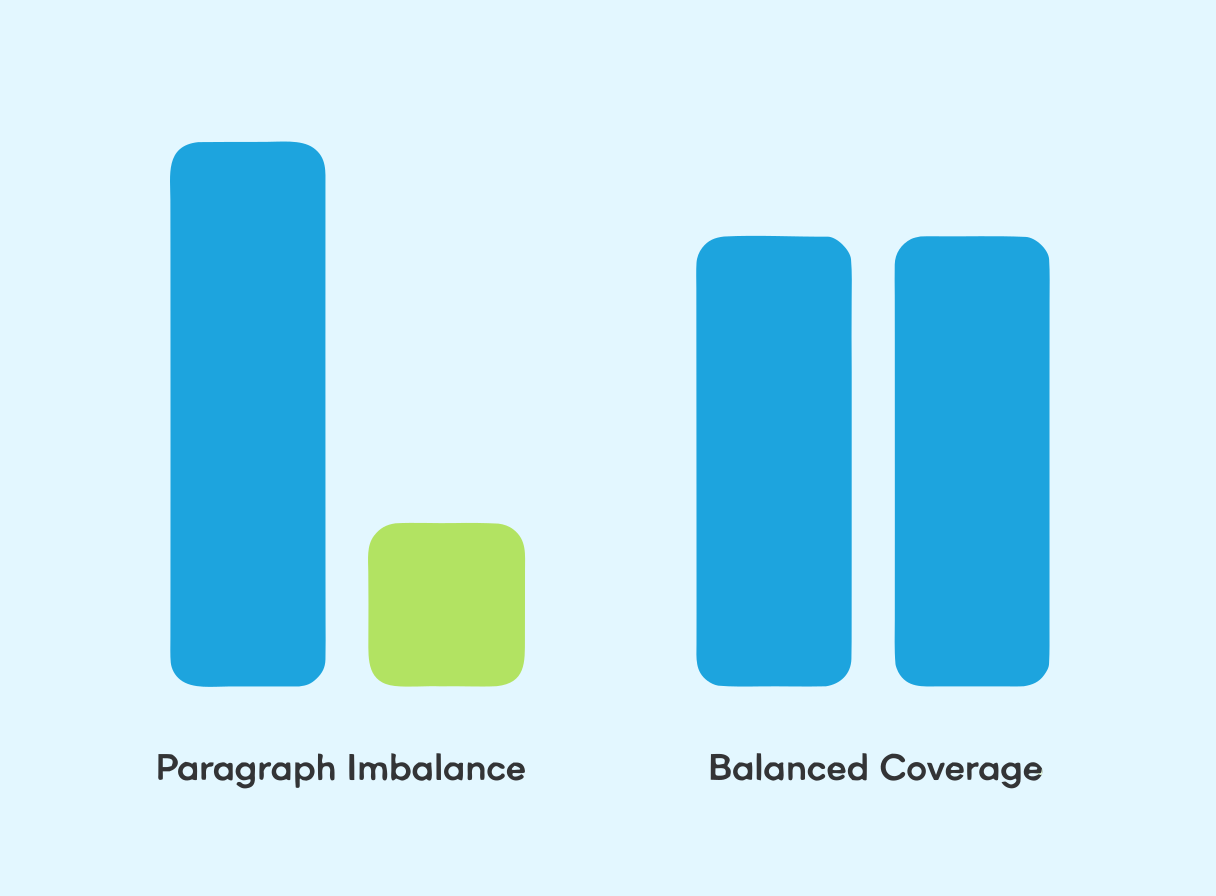
The most common error in a two part question IELTS essay is paragraph weight imbalance: candidates address the second sub-question at length and give the first only one or two thin sentences.
This happens for a predictable reason. The first sub-question is often analytical (“why does this happen?”) and feels harder to develop. The second tends to be practical (“what should be done?”) and produces ideas more quickly. Writers follow the easier path and produce an imbalanced response.
Task Response is scored against the complete essay, not its strongest section. Underdeveloping one sub-question limits the score even when the other paragraph is genuinely strong.
The correction is structural: plan both sub-questions in equal time before writing, and commit to a full paragraph for each.
Writing an Introduction That Covers Both Parts Without Repeating the Prompt
Your introduction must do two things: paraphrase the topic and signal that both sub-questions will be addressed. You do not need to state your answers yet.
A weak introduction echoes the prompt with minor word substitutions:
“These days, people work longer hours than before. This essay will discuss why this is and what can be done about it.”
A stronger version paraphrases both the topic and the implied questions in fresh language:
“Extended working hours have become a defining feature of professional life in many parts of the world. This essay examines the primary factors driving this pattern and outlines responses available to employers and governments.”
The stronger version does not copy the prompt’s phrasing and uses “examines” and “outlines” to do the structural signalling without announcing “this essay will answer two questions.” Developing this paraphrase-and-signal structure is one of the skills that separates Band 6 from Band 7 introductions.
How Many Paragraphs You Need and What Each One Should Do
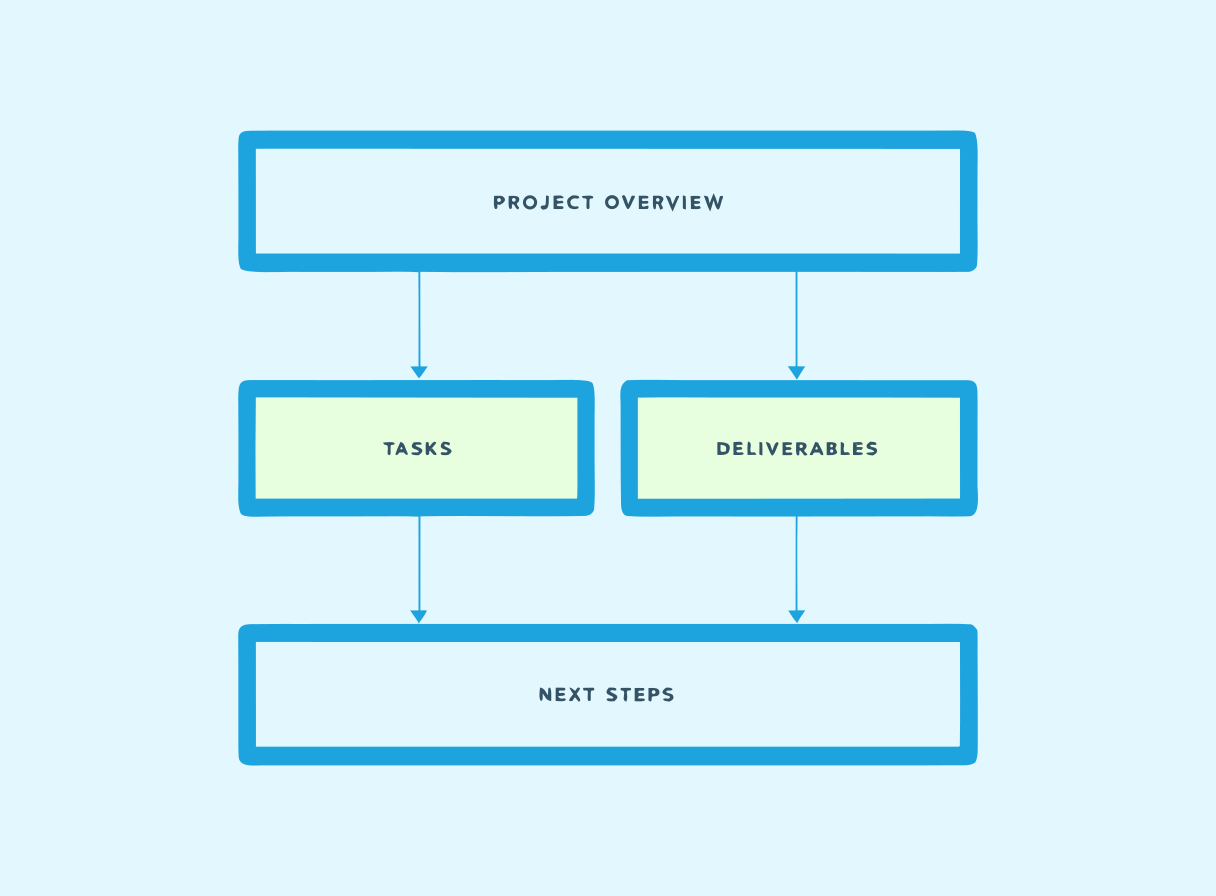
The standard structure for a two part question IELTS essay is four paragraphs:
- Introduction: paraphrase the topic and signal both sub-questions
- Body paragraph 1: answer the first sub-question with explanation and example
- Body paragraph 2: answer the second sub-question with explanation and example
- Conclusion: summarise both answers briefly
One paragraph per sub-question is the clearest way to show an examiner that the task has been fully addressed. Each body paragraph should open with a topic sentence that explicitly anchors to its specific sub-question. Do not open a paragraph with a general observation and expect the examiner to infer which question it addresses.
There is no rule requiring exactly four paragraphs. What matters is that both questions are answered clearly and with sufficient development. The four-paragraph structure is a reliable tool for achieving that, not a rigid template. You can also see how IELTS Writing assessment differs between tasks in this IELTS Writing band scores guide.
How Much Space Each Sub-Question Deserves
Neither sub-question automatically deserves more words than the other. The right allocation depends on how much you have to say about each part based on the specific prompt in front of you.
Both paragraphs need genuine development: a clear answer to the sub-question, at least one explanation, and at least one specific example or concrete detail. A paragraph that states a claim and immediately stops is underdeveloped regardless of its word count. Addressing “all parts” of the task is what matters, not reaching a particular paragraph length.
What Separates a Band 7 Two-Part Essay From a Band 6 One
At Band 6, the Task Response descriptors say “both parts of the task” are addressed but “some parts may be more fully covered than others.” At Band 7, the response “addresses all parts of the task” without qualification. The line is precise.
In practice, the Band 6 two part question IELTS essay typically shows one developed paragraph and one that is short, repetitive, or treated as an afterthought. The Band 7 response gives each sub-question a clearly structured paragraph with a topic sentence, specific support, and brief development of that support.
Two features consistently appear at Band 7 and are absent at Band 6: an explicit topic sentence anchoring each paragraph to its sub-question, and at least one concrete specific in each paragraph. Generic claims without grounding rarely reach Band 7, even with accurate language.
Cohesion Language for Moving Between the Two Sub-Questions
Coherence and Cohesion scores how clearly ideas are sequenced. The transition between your two body paragraphs is one of the most visible cohesion signals in a two part question IELTS essay.
When moving from body paragraph 1 to body paragraph 2, the opening sentence must signal clearly that a different sub-question is now being addressed. Phrases that work in British academic writing:
- “Turning to the question of what can be done…”
- “As for the practical responses available to policymakers…”
- “Regarding the second aspect of this issue…”
Avoid connectors that signal continuation within a single argument when you are shifting to a completely different sub-question. “In addition” and “also” imply the new paragraph is adding to the same point. When you are answering a separate question, these connectors can mislead the examiner about your structure.
For a wider view of what IELTS Writing tests compared to other exams, the IELTS vs TOEFL vs PTE guide and the IELTS Writing Task 1 vocabulary resource both cover scoring criteria that apply alongside Task Response.

Making the Two-Part Structure Automatic Under Timed Conditions
Structure becomes reliable under exam pressure only when it has been practised under timed conditions. Set a timer, read a two part question IELTS essay prompt, and complete a full response in 40 minutes, including two minutes of planning at the start.
The planning stage is worth those two minutes. A brief note before writing (sub-question 1: main point and one example; sub-question 2: main point and one example) prevents the imbalance error that costs candidates a full band point on Task Response.
After timed practice, the most useful feedback tells you specifically what your Task Response score would be and why. Knowing that your essay was “good overall” is not sufficient. Knowing that your second body paragraph answered the sub-question but lacked a concrete example, and that this holds your Task Response at Band 6, is the information that changes your next attempt.
Practise your Task 2 essays with Speechful’s IELTS Writing Task 2 for sentence-by-sentence feedback against each of the four official IELTS Writing criteria. You will see exactly where both sub-questions are addressed and where development is incomplete, which is the most direct route to making the two part question IELTS essay structure automatic before your test.