

The Essential IELTS Writing Task 1 Vocabulary Guide: Describe Trends and Data with Confidence
Choosing precise IELTS Writing Task 1 vocabulary is the most direct route to improving your Lexical Resource score. Candidates who plateau at Band 5 or 6 often understand the task format but reach for words that feel accurate and are not: dramatic verbs for modest movements, “fluctuate” where the data only dips once, or “improve” to describe a numerical rise. This guide explains the vocabulary system behind strong Task 1 responses, how to match words to what the chart shows, and which errors the examiner marks most consistently. For the full Task 1 Academic response structure, see IELTS Writing Task 1 Academic: Describing Charts, Graphs and Other Visuals.

Why Your IELTS Writing Task 1 Vocabulary Choice Carries 25% of Your Score
Lexical Resource is one of four equally weighted marking criteria in IELTS Writing Task 1, accounting for 25% of your score alongside Task Achievement, Coherence and Cohesion, and Grammatical Range and Accuracy. IELTS’s official band descriptors make the progression between bands concrete. At Band 6, the examiner notes some inappropriate word choices. At Band 7, the standard becomes sufficient range of vocabulary to allow some flexibility and precision, combined with awareness of style and collocation. At Band 8, the examiner expects a wide resource, used fluently and flexibly to convey precise meanings.
The jump from Band 6 to Band 7 is not simply about knowing more words. It requires both precision of choice and structural variety. Writing only “went up” regardless of magnitude demonstrates neither; alternating between “rose sharply” and “a sharp rise” shows the flexibility the Band 7 descriptor requires. See IELTS Writing Band 7 Requirements Explained for how all four criteria work together.
The Verb-Noun-Adverb Pattern: Why IELTS Task 1 Vocabulary Works as a System
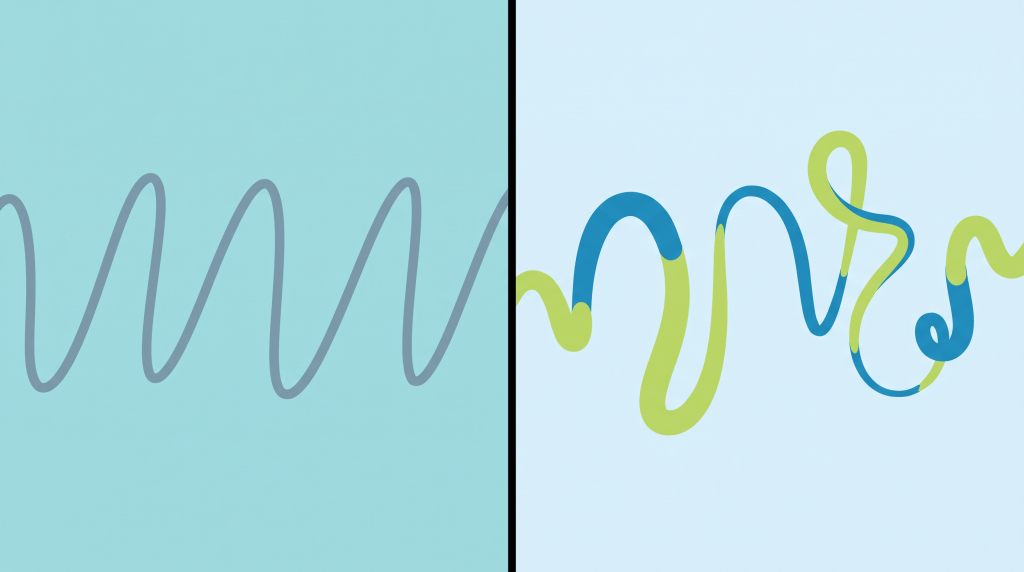
Every trend word in IELTS Writing Task 1 vocabulary belongs to a word family that allows the same meaning to be expressed with different grammar. “Rose sharply” (verb + adverb) and “a sharp rise” (adjective + noun) communicate identical information; using both across a response is precisely what “flexibility” means in the Band 7 descriptor.
The table below shows how upward, downward, stable, and fluctuating movements can each be expressed across four word classes. Practise substituting within rows: “there was a gradual decline” becomes “numbers declined gradually” or “a gradual fall was recorded.”
| Trend direction | Verbs | Adverbs | Adjectives | Nouns |
|---|---|---|---|---|
| Upward | rose, climbed, increased, grew, surged, soared | slightly, gradually, steadily, sharply, dramatically | slight, gradual, steady, sharp, dramatic | rise, increase, growth, surge |
| Downward | fell, dropped, declined, dipped, plummeted | slightly, gradually, steadily, sharply, dramatically | slight, gradual, steady, sharp, dramatic | fall, drop, decline, dip, plunge |
| Stable | remained stable, levelled off, plateaued, held steady | roughly, approximately | stable, flat, steady | stability, plateau |
| Fluctuating | fluctuated, varied, oscillated | considerably, markedly | variable, erratic | fluctuation, variation |
Words for Upward Movements
Not all upward verbs are interchangeable. The governing principle of IELTS Writing Task 1 vocabulary for upward trends is magnitude-matching: the word must reflect the scale and pace of the movement the chart shows. “Soared” implies a steep, rapid trajectory; applying it to a 3-percentage-point increase is the inappropriate word choice that holds a response at Band 6. The examiner rewards precision, not register. A working scale for upward movements:
- Marginal increase (under 5 percentage points): rose slightly, edged upward, increased marginally
- Moderate increase (5 to 20 percentage points): climbed, grew, rose gradually, increased steadily
- Large or rapid increase: surged, soared (only when the chart data shows genuine acceleration)
Adverbs follow the same principle: read the chart, assess the magnitude, then choose verb and adverb together.

Words for Downward Movements, Stable Periods, and Fluctuation
The magnitude-matching principle governing IELTS Writing Task 1 vocabulary applies to downward trends too. “Plummeted” is only accurate for a steep, rapid drop; “dipped” or “fell slightly” fit a minor decline.
For stable periods, the reliable choices are remained stable, held steady, levelled off, and plateaued. “Levelled off” implies a trend coming to rest after prior movement; it sits less naturally when data was flat from the start.
For fluctuating data, the critical constraint is frequency. IELTS Liz notes that “fluctuate” is accurate only when data moves up and down more than once across the period shown. A graph that rises and then levels off has risen and stabilised, not fluctuated. Using “fluctuated” for a single-direction movement remains an inappropriate word choice regardless of how varied the vocabulary otherwise is.
How Chart Type Changes the IELTS Writing Task 1 Vocabulary You Need
Trend verbs apply most naturally to line graph questions. IELTS Writing Task 1 includes multiple chart types, and vocabulary suited to a line graph often sounds awkward for a different visual.
Bar charts rely primarily on comparative language: “higher than,” “roughly twice as many,” “significantly greater than,” “a considerably smaller proportion than.” Pie charts require proportion and percentage language: “accounted for,” “represented,” “made up,” “the largest share belonged to.”
IELTS Writing Task 1 Academic sometimes pairs a line graph with a pie chart or table in the same question, requiring vocabulary from two registers simultaneously. Candidates who prepare only trend verb vocabulary will lack the language for the second chart.

Tense Accuracy in IELTS Writing Task 1: The Lexical Resource Rule Candidates Miss
Tense is a vocabulary decision, and examiners treat tense errors as both grammatical and lexical failures. Treating tense as part of IELTS Writing Task 1 vocabulary practice closes a gap that purely grammar-focused revision misses:
- Simple past for data covering a completed historical period: “the proportion rose between 2000 and 2020”
- Present perfect for data that extends up to now or whose effects continue: “the rate has increased since 2015”
- Present simple for predictions shown in the chart or for ongoing general patterns
Tense inconsistency for historical data is a common indicator of lowe-band writing. According to IDP IELTS preparation materials on key language for Task 1, this error surfaces repeatedly in lower-band submissions. Writing “the percentage increases between 2000 and 2020” in present tense not only makes a grammatical error; it undermines the accuracy of the verb choice.
A Band 5 and Band 7 Sentence Side by Side Using the Same Data
The practical impact of IELTS Writing Task 1 vocabulary precision is clearest in direct comparison, using the same data: public transport use rose from 20% to 45% between 2000 and 2020.
Band 5: “The percentage of public transport users goes up from 20% to 45% in 2000 to 2020.”
Band 7: “The proportion of the population using public transport rose significantly, climbing from 20% to 45% over the twenty-year period from 2000 to 2020.”
Three changes bridge the bands: past tense replaces present simple, the phrasal verb “goes up” becomes “rose significantly” with a magnitude-appropriate adverb, and a participial phrase (“climbing from”) supplies the structural variety the Band 7 descriptor requires. The official descriptor names “flexibility and precision”; this revision demonstrates both.
The Most Common Task 1 Vocabulary Mistakes and Why They Feel Correct
Three IELTS Writing Task 1 vocabulary errors appear persistently in Band 5 and 6 responses, and each feels natural in the moment.
“Improve” and “improvement” for numerical data. The problem is collocation: these words pair with conditions and situations, not raw figures. “Economic conditions improved” is correct; “the percentage improved from 20% to 45%” is not, because percentages rise, increase, or climb. This is one of the most reliable Band 6 errors in Task 1, and the self-correction difficulty stems from not knowing why the word feels right.
“Fluctuate” for a single rise then stability. Specific and technical, it feels like strong vocabulary. Using it for data that oscillates only once is still an inappropriate Lexical Resource choice.
Dramatic verbs regardless of scale. “Soared” and “plummeted” feel impressive, but the Band 7 descriptor rewards accurate choices. An incorrect word at high register is still a Band 6 marker. For related formal register patterns, see The Hidden IELTS Writing Formal Register Mistakes.
Task 1 vs Task 2 Writing: Different Vocabulary Pools, Different Skills
IELTS Writing Task 1 vocabulary and Task 2 vocabulary draw on different word pools, and preparing one does not prepare you for the other. Task 1 uses chart-specific language: movement verbs, magnitude adverbs, proportion phrases, and comparative structures. These words rarely appear in a strong Task 2 essay.
Task 2 writing draws on the Academic Word List for Task 2 essays: words such as “analyse,” “indicate,” “contribute,” and “demonstrate” that carry argumentative and analytical weight. They have almost no place in a chart description.
Candidates who rely solely on Academic Word List vocabulary often lack the right language for Task 1 charts. Keeping IELTS Writing Task 1 vocabulary practice distinct from Task 2 essay preparation resolves this gap.
Practising IELTS Writing Task 1 Vocabulary Until It Is Automatic Under Exam Conditions
Reading a vocabulary table builds awareness. It does not build automatic retrieval under a 20-minute time limit. The gap between recognising a word and producing it accurately under exam pressure closes only through repeated writing practice, not repeated reading.
The practice cycle that builds automaticity: write a full Task 1 Academic response using the vocabulary system in this guide, submit it for scoring against the four official IELTS Writing criteria including Lexical Resource, and review which word choices the scoring flags as accurate or inappropriate. That feedback loop is what converts recognition into production.
Speechful’s IELTS Writing AI grader scores Task 1 Academic responses against all four official IELTS Writing criteria, with sentence-by-sentence feedback on Lexical Resource. It is the practice tool for converting IELTS Writing Task 1 vocabulary knowledge into automatic retrieval when it matters. Start practising with instant Lexical Resource scoring at speechful.ai/ielts-ai.





You must be logged in to post a comment.