

IELTS Band Scores Explained for Vietnamese Students: The Honest Breakdown Every Candidate Needs Before Test Day
Understanding your IELTS band score is not simply a matter of knowing whether you passed or failed. For Vietnamese students, the band score system determines university admission, immigration eligibility, and visa applications. The difference between a 6.0 and a 6.5 can determine whether an application succeeds. Yet many Vietnamese candidates misunderstand how the IELTS band score is calculated, what each number actually represents, and which individual skill scores matter most for their specific goal.
This guide explains the IELTS band score system honestly, from the arithmetic of how your overall score is calculated to the specific band descriptor language examiners use at each level, with practical context for the most common Vietnamese application requirements.

How Your IELTS Band Score Is Calculated From Four Skill Scores
The IELTS overall band score is the average of four individual skill scores: Listening, Reading, Writing, and Speaking. Each skill is scored from 1 to 9 in 0.5-band increments. The four scores are added together and divided by four, then rounded to the nearest whole or half band according to the official IELTS rounding rules published by Cambridge English.
The rounding rule matters in practice. Averages ending in 0.25 round up to 0.5, and averages ending in 0.75 round up to the next whole number.
Here is a concrete example. If a Vietnamese student scores Listening 6.5, Reading 6.5, Writing 6.0, and Speaking 5.5, the average is 6.125. This rounds down to 6.0, not 6.5. If the same student improves Speaking to 6.0, the average becomes 6.25, which rounds up to 6.5. A single half-band improvement in Speaking changes the overall IELTS band score result.
This means Vietnamese candidates who are close to a target overall score should identify which single skill is pulling their average down most sharply. The IELTS band score system rewards targeted improvement more than moderate improvement spread evenly across all four skills.
What Each IELTS Band Score Means for Vietnamese Applications
The Cambridge English official IELTS band descriptors describe each band level in specific language.
Band 5 is a “modest user” who “handles basic communication in own field” with “frequent problems in understanding complex language.”
Band 6 is a “competent user” who “has generally effective command of the language despite some inaccuracies” and “can use and understand fairly complex language, particularly in familiar situations.”
Band 7 is a “good user” who “has operational command of the language” with “occasional inaccuracies” that “do not impede overall communication.”
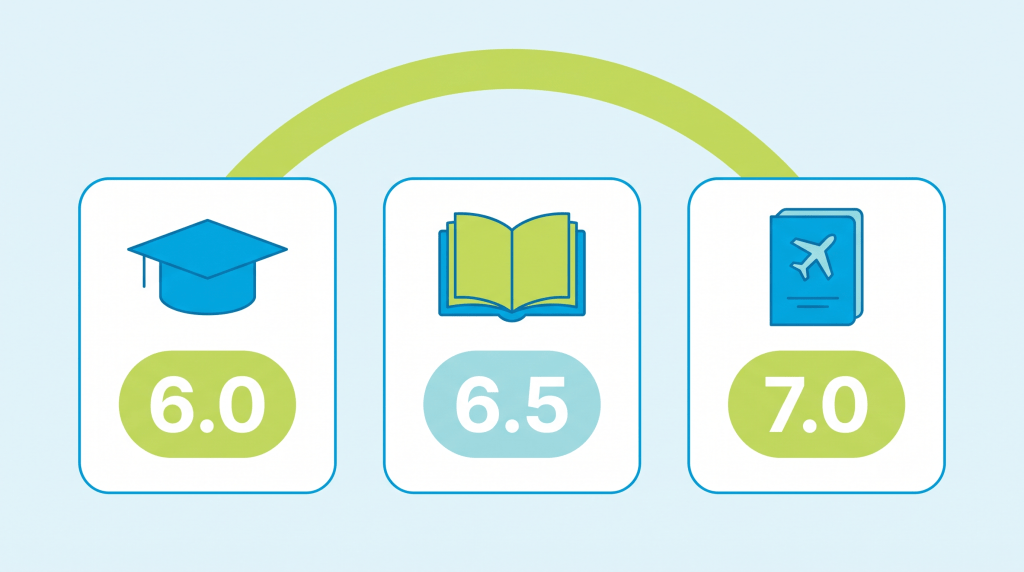
For Vietnamese students, the IELTS band score requirements vary significantly by application type. Vietnamese universities offering international programmes through partnerships typically require IELTS 6.0 to 6.5. Graduate programmes require 6.5 to 7.0. Vietnam National University (ĐHQG) and other major institutions use IELTS scores as a benchmark for international admission equivalency, with exact requirements set by individual faculties.
For immigration, requirements are specific by visa category. The Australian Skilled Independent Visa (subclass 189) requires a minimum IELTS band score of 6.0 in each of the four individual skills when applying without other English evidence, according to IDP IELTS Australia guidance. The UK Student Visa requires a minimum that varies between IELTS 5.5 and 6.5 depending on the institution and programme.
How Speaking Descriptors Apply to Vietnamese Learners at Band 5, 6, and 7
For Vietnamese students, the Speaking skill is frequently the lowest of the four IELTS band scores. This creates situations where a strong Reading or Listening result is offset by a weaker Speaking score, pushing the overall IELTS band score below target.
The Cambridge English Speaking band descriptors define the three most relevant levels as follows. At Band 5, the candidate “usually maintains flow of speech but uses repetition” and Pronunciation shows “noticeable first language accent” with “some mis-pronounced phonemes.” At Band 6, speech is extended but “uses fillers to maintain speech while searching for language,” and vocabulary is “generally used appropriately” though with “limited ability to use less common items.” At Band 7, the candidate “speaks at length without noticeable effort” and uses vocabulary “with flexibility and awareness of style,” while the accent “has minimal impact on intelligibility.”
Vietnamese L1 speakers typically plateau at Band 6 for two specific reasons: final consonant deletion in English (which affects both Pronunciation and Grammatical Range and Accuracy) and tonal pitch carry-over that disrupts English sentence-level intonation. Neither is a permanent ceiling. Both respond to structured practice with criterion-specific feedback. The IELTS Speaking common mistakes guide covers the per-criterion error patterns that explain most Band 6 plateaus.
The Biggest Misconception About Raising Your IELTS Band Score
Vietnamese candidates frequently believe that their IELTS band score is primarily a test of vocabulary size: that expanding their word list will raise all four skill scores simultaneously.
This misunderstanding is understandable. Vocabulary is visible and measurable in a way that other skills are not. But the four IELTS scores are independent assessments with separate criteria. A larger vocabulary does not directly raise a Fluency and Coherence score. Coherent, extended responses do. A larger vocabulary does not raise a Pronunciation score. Controlled phoneme production, word stress, and sentence rhythm do.
What examiner guidance published through IDP IELTS consistently shows is that candidates who improve their IELTS band score most efficiently do so by identifying which sub-criterion within their weakest skill is producing the most score impact, and addressing that directly. A Vietnamese candidate whose Speaking plateau sits at 6.0 despite three months of vocabulary study may find that focused intonation practice moves the score faster than any word list.
How IELTS Writing Scores Are Calculated Across Four Criteria
The IELTS Writing section is scored across four criteria, each weighted at 25% of the Writing IELTS band score. The criteria for Task 2 (worth twice as many marks as Task 1 within Writing) are: Task Response, Coherence and Cohesion, Lexical Resource, and Grammatical Range and Accuracy.
For Vietnamese writers, the lowest-scoring criterion is typically Grammatical Range and Accuracy. Vietnamese does not have a grammatical article system (no equivalents of a, an, or the), and Vietnamese is a topic-prominent language rather than a subject-prominent one. These two transfer patterns create consistent errors that directly affect Grammatical Range and Accuracy.
Cambridge English defines Band 6 for Grammatical Range and Accuracy as “a mix of complex and simple structures” with “some errors” that “do not impede communication,” while Band 7 shows “a variety of complex structures” with “frequent error-free sentences.” Moving between these levels requires accurate application under timed conditions, not just grammatical knowledge.
The Writing section also includes Task 1. Task 2 counts for double the marks of Task 1 within the Writing IELTS band score. For Vietnamese candidates with limited study time, prioritising Task 2 practice produces the fastest score improvement. The IELTS Writing band 7 requirements guide explains the specific criteria thresholds across both tasks.

What Separates Band 6 from Band 7 in IELTS Speaking
The single most important distinction in the IELTS band score system, for most Vietnamese candidates, is the difference between Band 6 and Band 7 in Speaking. The official Cambridge English descriptors make this distinction concrete.
For Fluency and Coherence: Band 6 candidates show “willing to attempt communication” but with hesitation and “some loss of coherence.” Band 7 candidates “speak at length without noticeable effort” with any hesitation not impeding meaning.
For Pronunciation: Band 6 shows “accent may affect intelligibility at times.” Band 7 shows “accent has minimal impact on intelligibility.” The shift is from “at times” to “minimal.” This is where tonal carry-over and final consonant deletion most often determine a Vietnamese candidate’s IELTS band score.
For Grammatical Range and Accuracy: Band 6 produces “a mix of complex and simple forms with some errors.” Band 7 produces “a variety of complex structures with frequent error-free sentences.”
For Lexical Resource: Band 6 shows “generally uses vocabulary appropriately” but with “limited ability to use less common items.” Band 7 shows “uses vocabulary with flexibility and awareness of style.”
Each of these distinctions is actionable. Knowing exactly which descriptor applies to your current output tells you the specific change that will move your IELTS band score.
What Vietnamese Universities and Visa Programmes Require
Band score requirements vary across Vietnamese application contexts. The following reflects requirements current as of 2026; candidates should verify directly with institutions and authorities before applying.
For undergraduate admission at Vietnamese public universities with international programmes: IELTS 6.0 is typically the minimum. Selective institutions and joint-degree programmes often require 6.5 to 7.0.
For postgraduate study abroad: UK universities typically require IELTS 6.5 (and a minimum of 5.5 to 6.0 in each individual skill). Australian universities typically require 6.5 to 7.0, with some programmes requiring higher IELTS band scores for specific skills such as Writing.
For immigration: The Australian Skilled Nominated Visa (subclass 190) and similar skilled migration pathways typically require a minimum IELTS band score of 6.0 in each skill. Individual requirements vary by occupation and pathway; candidates should verify with the Department of Home Affairs or a registered migration agent.
For professional registration: Healthcare professionals registering with the UK Nursing and Midwifery Council require IELTS 7.0 in Listening, Reading, and Speaking, with a minimum of 6.5 in Writing. This is one of the most stringent IELTS band score requirements Vietnamese nurses and doctors encounter when planning to work abroad.

If Your Overall IELTS Band Score Is 6.5 but Speaking Is 5.5
An overall IELTS band score of 6.5 can emerge from very different individual skill combinations. A candidate with Listening 7.5, Reading 7.0, Writing 6.5, and Speaking 5.5 achieves the same overall 6.5 as a candidate with Listening 6.0, Reading 6.5, Writing 7.0, and Speaking 7.0.
This matters because many programmes and visa pathways specify minimum scores in individual skills, not just the overall IELTS band score. If your 6.5 overall includes a Speaking sub-score of 5.5, you may fail the individual skill requirement for several destination universities and most skilled migration pathways, even if your overall score exceeds the threshold.
The correct interpretation of a 6.5 overall with 5.5 Speaking is: you have two to three months of focused Speaking work ahead of you before retesting. The goal is raising Speaking to at least 6.0, which changes the overall IELTS band score calculation. The other skills are already at or above threshold and should be maintained rather than further improved.
How Long It Realistically Takes Vietnamese Learners to Move From Band 5.5 to Band 7
Moving one full IELTS band score in Speaking, from 5.5 to 6.5, typically requires three to six months of consistent, deliberate practice for a motivated Vietnamese candidate. Moving 1.5 bands from 5.5 to 7.0 typically requires six to nine months, assuming at least one hour of focused Speaking practice per day.
These timelines assume practice is structured around the specific error patterns identified in the candidate’s current responses. A Vietnamese candidate who spends six months on vocabulary study without specific Speaking practice is unlikely to see meaningful IELTS band score improvement in Speaking.
Honest caveats apply: timelines vary based on starting level, practice consistency, quality of feedback, and individual factors. No preparation programme can guarantee a specific IELTS band score in a fixed number of months. Skill-building is individual. The only reliable predictor is the quality of practice, not its quantity alone.
How Practising Against Official Descriptors Closes the IELTS Band Score Gap
The most direct preparation path for Vietnamese students targeting IELTS band score improvement in both Speaking and Writing is practising with feedback tied explicitly to the official band descriptors that examiners use.
When you give a Part 2 response or write a Task 2 essay and receive feedback that names the criterion, references the relevant descriptor language, and identifies the specific sentence or moment where the score was affected, you are learning exactly what the examiner observes. This is qualitatively different from receiving a general grade.
Practise your IELTS Speaking and Writing with Speechful’s IELTS Speaking AI grader and IELTS Writing AI grader, both of which score responses against the four official criteria and give you the sub-criterion feedback that shows where your IELTS band score is being set and why.




You must be logged in to post a comment.